Showing posts sorted by relevance for query Linked Assisted Suicide Posts. Sort by date Show all posts

10/3/12

Cardinal O'Malley on Physician Assisted Suicide


Cardinal Sean O'Malley, the Archbishop of Boston, posts every Friday night on his blog.

Anticipating a question that will appear on the ballot in Massachusetts on November 6, Cardinal Sean posted a statement last week on this critical issue.

Though the matter of physician assisted suicide may not be appearing on the ballot where you live, the moral question involved and our response to it is very much alive in contemporary culture and certainly deserving of our attention.

Here's the beginning Cardinal Sean's post, followed by a link to the complete statement.
Suicide is always a tragedy
Most people I know have lost a friend, a family member or loved one to suicide. Sometimes the depression and anxiety had been apparent for a long time; other times people are taken completely off guard, not even suspecting the deep torment that a loved one endured secretly.

We have come to appreciate how dangerous depression can be. It is like quicksand that devours a person in the unstoppable urge to self-destruction. Sometimes we experience a rash of suicides in a community, as one depressed person — upon hearing of a friend, acquaintance or even a stranger, who takes his own life — repeats that action. The copycat syndrome is a very real danger. The suffering of a suicide reverberates in the psyche of friends, relatives and co-workers and also in people who have attempted or considered suicide in the past. Suicide always affects other people; it is never an act that only affects the individual involved. Family members, friends and neighbors often are filled with lingering sadness, guilt and confusion. Sometimes those who are closest to the deceased never completely recover, never forgive themselves and are haunted for the rest of their lives by the loss.

There are dedicated suicide prevention organizations like the Samaritans that stand ready to help people in the throes of depression and suicidal thoughts. Many volunteers stand ready on their hotlines, always prepared to try to bring solace and help to those suffering from suicidal impulses. There are also heroic first responders who often risk their lives to help stop someone from taking one’s own life. All of us are called upon to be Good Samaritans and to work to prevent suicides in our community.

The World Health Organization (WHO) studies suicides throughout the world. One of their pleas to governments is to avoid presenting suicide as a solution to peoples’ problems. In a way, that is what physician-assisted suicide is doing for one group of people — those with terminal diagnoses of six months or less. Oregon, the first state to legalize physician-assisted suicide, has one of the highest rates of suicide (not including deaths from PAS) of any state in the nation. It begs a logical question: how can a state effectively both try to minimize suicide in some situations and promote it as a legal alternative in other situations? There is no doubt that efforts to prevent suicides will be undermined by legalizing suicide for those with terminal diagnoses and presenting it as normal and acceptable. Suicide, in any form, is always a tragedy — a tragedy that all people of good will should work to prevent...
(Read Cardinal Sean's complete statement here)
You'll find previous posts on this topic (with video) here,  here, here and here.

Linked Assisted Suicide Posts


Subscribe to A Concord Pastor Comments 

10/5/12

More from Cardinal O'Malley on the question of physician assisted suicide


I have posted several times on Question 2 which will appear on the ballot in Massachusetts on November 6, 2012.  Question 2 deals with physician assisted suicide.

Here's another statement from Cardinal Sean, indicating those groups who, in agreement with the Catholic Church, are opposed to the so-called "death with dignity" initiative.
This election day, Massachusetts voters will be asked to vote on Question 2: “Prescribing Medication to End Life”. This question would, if passed, legalize doctor prescribed suicide in our commonwealth. This week, I am continuing my series of reflections on why I believe all people of good will should join me in opposing this deplorable ballot question.

Question 2: A flawed law, a false choice
For many people, opposition to physician-assisted suicide is based on respect for God’s law "Thou shalt not kill," and on the firm desire to have doctors and nurses function as healers and care givers, not executioners. For 2,500 years doctors have taken the Hippocratic Oath, promising to practice medicine ethically and honestly. Part of the promise is "to do no harm." Indeed, the oath is very explicit about rejecting physician-assisted suicide, promising "I will never give a deadly drug to anybody if asked for it, nor will I make a suggestion to this effect."

Although these promises originated in the ancient world in pre-Christian times, they have always guided conscientious physicians in the ethical practice of the healing arts. To jettison these moral guidelines would have a very detrimental effect on the medical profession and on society.

The American Medical Association (AMA) has stated that "physician-assisted suicide is fundamentally incompatible with the physician’s role as healer, would be difficult or impossible to control, and would pose serious societal risks. Instead of participating in assisted suicide, physicians must aggressively respond to the needs of patients at the end of life. Patients should not be abandoned once it is determined that cure is impossible. Multidisciplinary interventions should be sought including specialty consultation, hospice care, pastoral support, family counseling, and other modalities. Patients near the end of life must continue to receive emotional support, comfort care, adequate pain control, respect for patient autonomy, and good communication."

Locally, the Massachusetts Medical Society (MMS) voted overwhelmingly against assisted suicide and have said that "assisted suicide is not necessary to improve the quality of life at the end of life. Current law gives every patient the right to refuse lifesaving treatment, and to have adequate pain relief, including hospice and palliative sedation." In describing their specific opposition to Question 2, the MMS stated further that "The proposed safeguards against abuse are insufficient. Enforcement provisions, investigation authority, oversight, or data verification are not included in the act. A witness to the patient’s signed request could also be an heir."

There are many citizens of the Commonwealth of Massachusetts who do not share our faith and for whom the clear biblical teaching is not a convincing argument. To them, we make an appeal to reason: that this is bad legislation because it puts vulnerable people at risk and it promotes suicide. Many have already recognized the flaws and the dangerous aspects of physician-assisted suicide as presented in Question 2 on the Massachusetts ballot this November. Opposition to Question 2 is coming from a broad array of organizations and individuals who often do not agree on other initiatives or proposed laws...
(Read the rest of the Cardinal's statement here.)

And here's a link to a video presentation of a "town hall" meeting on this matter, hosted by the Archdiocese of Boston.

Linked Assisted Suicide Posts


Subscribe to A Concord Pastor Comments 

10/20/12

More on Question 2 from Cardinal Sean


On his blog this week, Cardinal Sean O'Malley offers yet another post regarding Question 2 on the November 6  Massachusetts ballot, the question on physician assisted suicide.  Below I've listed the titles of the ten reasons Cardinal Sean proposes for voting No on Question 2.  Each of these titles heads a fuller explanation which I encourage you to read on his page.

You'll find Cardinal Sean's previous posts on this topic (with video) here, here,  here, here and here.


Ten reasons to oppose Question 2
There are many groups opposing the legalization of assisted suicide in the Commonwealth of Massachusetts and that are urging a "No on Question 2" vote this Nov. 6. In total, more than 100 reasons to oppose this ballot measure have been shared with me since we began our educational efforts on this issue. Some arguments are based on principle, others on prudence, and still others on process — and all of them are valid. Today, I want to share with you ten of the most compelling. In turn, I encourage you to share these reasons with all those you know between now and Election Day.
(1) Question 2 would legalize assisted suicide; suicide is always a tragedy and never a dignified way to die. 

(2) Suicide always impacts others beyond the individual that takes his or her life. Proponents of

(3) Doctors strongly oppose assisted suicide and Question 2.

(4) Advocates for the disabled strongly oppose assisted suicide and Question 2.

 (5) Terminal diagnoses are often wrong.

(6) Question 2 is shockingly flawed.

(7) Question 2 does not require a patient to consult with a psychiatrist or palliative care expert before receiving the lethal prescription.

(8) Question 2 does not require family notification.

(9) Assisted suicide would weaken efforts to expand and improve palliative care.

(10) Complex issues like assisted suicide should be decided in a legislative process rather than a ballot initiative.

 Read the complete post on on the Cardinal's blog.

Linked Assisted Suicide Posts


Subscribe to A Concord Pastor Comments 

11/2/12

Boston Globe on Question 2


An editorial in the Boston Globe does not support ballot question 2 on physician assisted suicide, which question will be put to Massachusetts voters on November 6.

Massachusetts, like most of the United States, has been in a woeful state of denial about the way its medical system handles the end of life. Too often, doctors shy away from frank discussions with terminally ill patients about their options — from continuing treatment, to palliative care, to some combination of both. Worse, society is so scared of such conversations — so conflicted about how far doctors should go in declaring a patient’s condition to be terminal, so reluctant to ever give up hope — that many insurers, including Medicare, don’t even cover the cost of an end-of-life conversation. Instead, they keep plowing money into treatments, while too many lives end in hospital beds, after unnecessarily painful side effects from unsuccessful drugs and devices.

Now, like a clanging wake-up call, comes the Question 2 “death with dignity” ballot initiative, which would establish procedures under which doctors could prescribe life-ending drugs to terminally ill patients. It draws heavily on the experiences of the two states that allow so-called physician-assisted suicide, Oregon and Washington. But it’s not, in itself, an answer to the far deeper question of how to help patients make end-of-life decisions.

Even in Oregon, which first approved physician-assisted suicide in 1994, only 71 people took advantage of it last year. Most were cancer patients. But many other dying patients, from those with degenerative physical conditions like Lou Gehrig’s disease to those with mental deterioration from Alzheimer’s and other conditions, weren’t eligible because they couldn’t satisfy both the requirement of mental fitness and the ability to administer the drugs themselves.

And rather than bring society to a consensus on how to approach the end of life, Question 2 adds new and divisive questions to the mix: Should doctors actually help people die more quickly, rather than merely withhold treatment? Does such a regimen serve to weaken society’s belief that lives — even those of the seriously ill, or severely disabled — have value and are worth living?

Such questions draw on individual beliefs and morals, and defy practical analysis. Reasonable people can disagree passionately about Question 2, but a yes vote would not serve the larger interests of the state. Rather than bring Massachusetts closer to an agreed-upon set of procedures for approaching the end of life, it would be a flashpoint and distraction — the maximum amount of moral conflict for a very modest gain.

Instead, Massachusetts should commit itself to a rigorous exploration of end-of-life issues, with the goal of bringing the medical community, insurers, religious groups, and state policy makers into agreement on how best to help individuals handle terminal illnesses and die on their own terms.

Most importantly, patients need a realistic assessment of their disease, its prognosis, and the range of treatment options before them. Access to palliative care, psychiatric therapy, and hospice nurses are already covered by Medicare and most insurers. Such services may sound elaborate, but are actually far less costly than the intensive care that so often attends last-ditch treatments.

Physician-assisted suicide should be the last option on the table, to be explored in a thorough legislative process only after the state guarantees that all its patients have access to all the alternatives, including palliative care. Question 2, which would require that two licensed physicians confirm that patients have less than six months to live but are competent to make their own decisions, has drawn the opposition of the Massachusetts Medical Society, which argues that physicians shouldn’t be put in the position of ending people’s lives.

Further, the society argues, physician-assisted suicide is unnecessary in light of patients’ “right to refuse lifesaving treatment, and to have adequate pain relief, including hospice and palliative sedation.” The medical society’s position is reasonable, but too few patients get the information necessary to assert those rights. It’s up to the state’s physicians to take the lead in making sure that patients are aware of their options and take full advantage of them; all available evidence suggests that many more would do so, if only they had the proper information and encouragement.

Then, and only then, would the need for physician-assisted suicide become apparent. If the process of dying becomes more manageable, more dignified, and more comfortable, then fewer patients would seek to hasten it along. Doctors would be spared a vexing set of decisions. The seriousness with which the state is approaching Question 2 is, in itself, an indictment of the current state of end-of-life care. More than a cry for physician-assisted suicide, it’s a plea for greater dignity at the end of life. And that request, at least, should be answered.


For previous posts on this topic, click here.
Linked Assisted Suicide Posts


Subscribe to A Concord Pastor Comments 

10/13/12

More from Cardinal Sean on Ballot Question 2


Here's another in a series of columns (see also here and here) on physician assisted suicide (a question on the Massachusetts ballot this November 6) from the blog of Cardinal Sean O'Malley:

The slippery slope of assisted suicide
Proponents of physician-assisted suicide tell us that there is no danger of a slippery slope, that in Oregon the cases are “not that numerous” and are “carefully monitored.” I hope that reasonable people will question these claims and reflect further on whether a law with insufficient safeguards is what we want in the commonwealth.

Slippery slope arguments involve small decisions that lead to undesirable outcomes that never would have been supported at the outset. Often, it is impossible to prove that one small step will have significant negative effects, but common sense allows reasonable people to judge the likelihood that a sequence of events that have happened in one place are likely to happen in another place in a similar way.

Question 2 proposes to allow physician-assisted suicide for those diagnosed with a terminal illness with six months or less to live. Many groups are concerned that, if passed, it not only would be harmful in itself, but could lead to unintended tragic outcomes. (1) Elder advocates are concerned that it could become a new form of elder abuse. (2) Advocates for the disabled are concerned it could lead to “quality of life” standards in our society, where those with a lower perceived quality of life receive fewer benefits or protections. (3) Doctors and nurses are concerned it could lead to a lower “quality of care” for those at the end of life. (4) Doctors are also concerned that it could undermine the doctor-patient relationship. (5) Ethicists are concerned that it could lead to a devaluing of human life. (6) Suicide-prevention organizations are concerned that the state legally allowing suicide for one group (those with terminal diagnoses of fewer than six months to live) could lead to increased suicide rates for the rest of the population. (7) Those who have studied the evolution of this matter in the Netherlands are concerned that assisted suicide could lead, first to voluntary euthanasia (requesting direct help to end one’s life), and then to involuntary euthanasia (where a third-party determines that, if the patient were in his right mind, he would choose euthanasia).

Asserting that something could happen is not the same as stating that something will happen. Here are some facts that lead the groups above to be concerned. Please judge for yourself whether you agree with the risk that one or all of these concerns might occur in Massachusetts if we took the first step this Election Day by voting to legalize assisted suicide.

(Be sure to link to Cardinal Sean's blog for "the rest of the story...")
Linked Assisted Suicide Posts


Subscribe to A Concord Pastor Comments 

10/27/12

More from Cardinal Sean on Assisted Suicide


This is Cardinal Sean O'Malley's homily for the 30th Sunday in Ordinary Time, October 28, 2012. Question 2 on the ballot in Massachusetts for the election on November 6 deals with phsyician assisted suicide.

You'll find links to and portions of the Cardinal's 8 previous posts on this question here.


Linked Assisted Suicide Posts


 Subscribe to A Concord Pastor Comments 

9/22/12

Physician assisted suicide on the ballot on Nov 6


This video presents Cardinal Sean O'Malley's remarks in a recent webinar on physician assisted suicide, which question will be on the ballot in Massachusetts on November 6 this year.  The ballot question will appear under the dubious title, "Act Relative to Death with Dignity."  Voters will do well to read ahead of time the complete text of the act as it will appear on the ballot.

Here's the Cardinal's introduction to the video from his blog:
(In the webinar) we discussed several concerns with the proposed law. We began with reasons why those who are concerned with the dignity of life and advocates for those with disabilities would be likely to oppose this ballot initiative. Second, we addressed the many flaws in the way the proposed law is written. And thirdly, we spoke about concerns that this is not an appropriate way to make legislation on such a complex issue. Rather than having the legislature study this issue and hold debates and hearings, many voters are likely to make their decision based on sound bites and snippets of information they have heard from both sides.
Linked Assisted Suicide Posts


Subscribe to A Concord Pastor Comments 

10/12/12

LIfe decisions


My classmate and friend, Monsignor Paul Garrity, has this fine column in his parish bulletin dated October 7, 2012 and the same appears in this week's edition of The Pilot, the weekly newspaper of the Archdiocese of Boston.  (Note: The ballot on November 6 will include, in Massachusetts, a question on physician-assisted suicide.)  Here's Paul's column:
Respect Life Sunday is an annual recognition that the central moral question of our age has to do with preserving the dignity of human life from the mounting encroachments of our secular world. The so called Death with Dignity referendum that will be on our ballots come November is the latest and most challenging threat to human dignity since the infamous Roe v Wade Supreme Court decision of 1973. The fact that prognosticators and pundits are forecasting a "win" for this referendum should give us all a reason to pause and reflect on the culture that may bring this about. 

The Roe v Wade decision was not directly about the legitimacy of abortion. The Court's decision that effectively allowed abortion on demand rested on what it termed a constitutional right to privacy. Because of this so called 'right to privacy,' all laws prohibiting abortion throughout the United States were effectively thrown out. What is most interesting about the current Death with Dignity referendum and Roe v Wade is that both have their roots in a philosophy of individualism that is at odds with the basic instincts of a liberal society. 

The "New Deal," the "Great Society" and even "compassionate conservatism" recognize that there are basic injustices and inequalities in society that need to be addressed by government. Our society cannot be ruled by the law of the jungle where only the powerful survive. Because we are a civil society, we have a responsibility to care for one another. The so called "safety net" is not a luxury that can be jettisoned when the economy turns sour. Rather, it is our fundamental obligation as a self- governing people if we are to call ourselves a civilization. 

The "individualism" of Death with Dignity and Roe v Wade ignore the notion that we, citizens of our republic, are a community of persons. The notion that I can do anything I want as long as it doesn't interfere with someone else's life pretends not to notice that by our very nature , as Aristotle observed, we are social beings. We are connected to one another. We are all in this thing called "society" together. While this may seem to some to be an overly spiritual concept that does not belong in the public square, the domestic budget of our nation draws its legitimacy and vitality from this simple concept. 

This year, Respect Life Sunday needs to have a particular focus on the Death with Dignity referendum. To begin with, this title intentionally obscures the substance of the issue. Every- one agrees that every person should be allowed to die with dignity. What this piece of legislation does, however, is legitimize suicide by terminally ill people who see no alternative to their suffering but taking their own lives. In this legislation, the word dignity completely cloaks the hopelessness and despair that some terminally ill people face. 

The question we really should be asking has to do with how we care for dying people. If suicide is the best that we can offer the terminally ill, then we certainly have come a long way from the notion of a civil society where we acknowledge a responsibility for one another. Today, Hospice and other forms of palliative care offer far more to the terminally ill than suicide ever can. This is where our attention needs to be focused as we head toward November. And this should be our response to those who think otherwise.
Linked Assisted Suicide Posts


Subscribe to A Concord Pastor Comments 
2/12/12

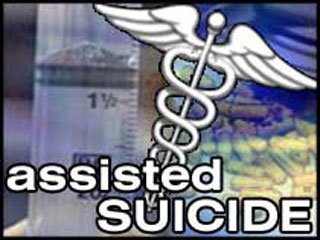
Physician-prescribed suicide


A reader asked about Cardinal Sean O'Malley's video homily for this weekend. The Archdiocese of Boston is preparing for the possibility that a referendum on physician-assisted suicide may appear on the November 2012 ballot.

More information is available from the Archdiocese here.

Linked Assisted Suicide Posts


Subscribe to A Concord Pastor Comments 

10/1/12

Voting on Question 2 on November 6


Fr. Bob Reed, Director of CatholicTV, offers this series of 5 spots on physician-assisted suicide and the related question on the November 6 ballot in Massachusetts.

Each spot begins with the same intro but goes on to address a different aspect of the question.

Linked Assisted Suicide Posts


Subscribe to A Concord Pastor Comments 

11/1/12

Four point plan on Question 2 from Cardinal Sean


Cardinal Sean suggests a four point plan on Ballot Question 2 for the time remaining between now and the election.

The four points are:
1) Voting and helping others get to the polls.
2) Personal outreach to at least 10 people by direct mail or by phone.
3) A message to your contacts through FaceBook, Twitter or a general email.
4) Praying for the grace of understanding, courage and discernment.

Read the whole plan here.

Read previous posts on this topic here.

Linked Assisted Suicide Posts


Subscribe to A Concord Pastor Comments
